Pontifical University of the Holy Cross, Rome, Novembre 18 2025
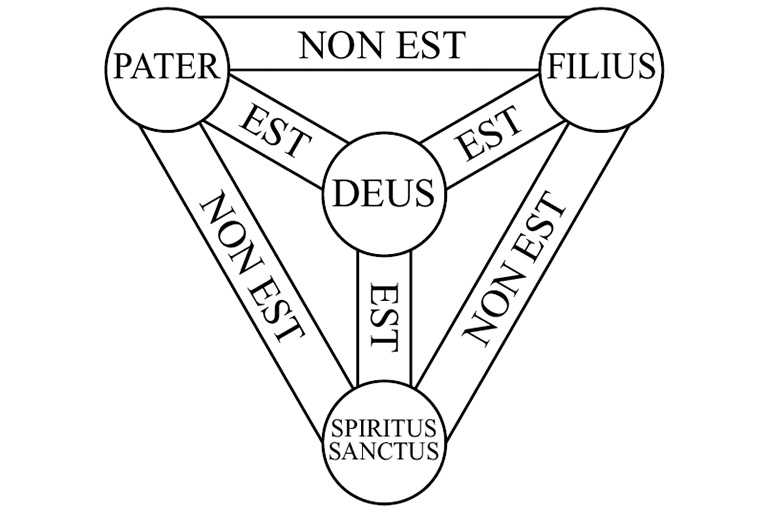
On 18 November 2025, Professor Ciro De Florio from the Catholic University of the Sacred Heart held a workshop for the ROR titled “Identity, constitution, and the logical problem of the Trinity”. Starting from the definition of the Trinity contained in the Catechism of the Catholic Church (CCC 253), De Florio presented the logical problem of the Trinity, stating beforehand that the philosophy of religion in many fields is marked by an intrinsic interdisciplinarity, where the boundary with philosophical theology is blurred by mutual and fruitful cross-pollination.
- There is only one God; 2. the Father is God; the Son is God, the Spirit is God; 3. the Father, the Son, and the Spirit are three different Persons. Thus, the problem of the Trinity, stated in logical terms, corresponds to a logical contradiction, whether the “is” in the second statement is interpreted in terms of “identity,” or whether the same copula is considered as a “predicate of divine being”. In both cases – De Florio explained – the interpretive investigation encounters a contradiction, and as is well known in the field of logic, that which is contradictory is false.
The effort to overcome this impasse has seen numerous scholars, since the middle ages, strive to construct various interpretive solutions. Regarding the contemporary era, Professor De Florio presented the participants with three proposals for explanatory analogy, highlighting their strengths and weaknesses, while declaring that he did not endorse any of them. Among these, the first to be illustrated was Brian Leftow’s proposal, “Time travel and the Trinity”, in which the same dancer uses a time machine to travel back and offer a dance performance involving three different performers. The significance of this proposal is rooted in the supposed “metaphysical fission”: the three different dancers are, in fact, the same Person across three overlapping timelines.
The proposals of scholars such as Geach, concerning the relativisation of identity, wherein identity is seen as a relation that every object has with itself, and Michael C. Rea, who proposes a metaphysics of constitution, integrated with Aristotelian hylomorphic theory, were also illustrated. During the debate, many hermeneutical difficulties arose regarding the logical value of the arguments and the underlying ontological premises, which nonetheless encouraged participants to verify their own positions through interdisciplinary dialogue. These difficulties are largely rooted in the premise that, in the logical formulation of the argument, real relations are not contemplated; they are absent from the question of distinction. Aristotle would say that, relative to substance, they are accidents. Nevertheless, relations represent a fundamental element of knowledge in the theological domain, essential for distinguishing and qualifying both the identity and the real distinction of the Persons. The debate demonstrated that dialogue is possible but that continuous study and research are necessary.