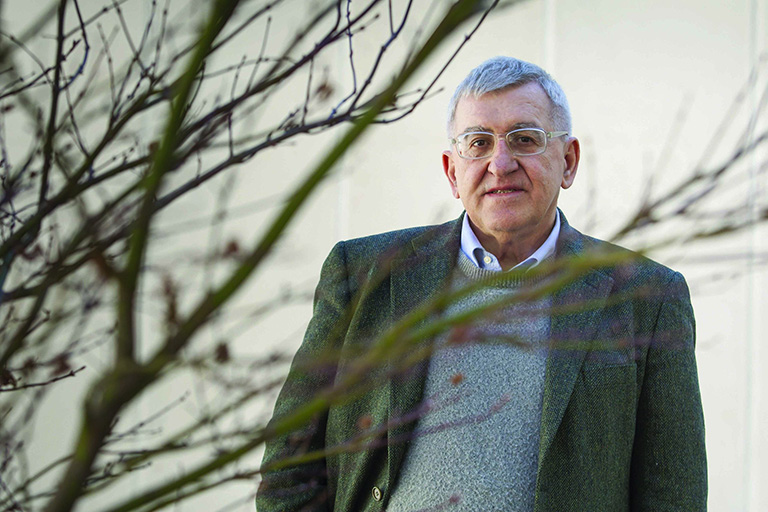
Pontifical University of the Holy Cross, Rome, October 8 2025
On 8 October 2025, on the occasion of the conferral of the honoris causa doctorate, the ROR organised an afternoon seminar in honour of Professor Pierpaolo Donati, dedicated to his book La relazione con Dio. Quale alterità tra l’umano e il divino? (The Relation with God. What Alterity Between the Human and the Divine?). Professor Luis Romera (PUSC), Professor Antonio Malo (PUSC), and Professor Giulio Maspero (PUSC) participated, engaging in dialogue with the author under the moderation of Ilaria Vigorelli (PUSC). Luis Romera, in opening the proceedings, defined the book as a “synthesis effort” concentrated toward the apex where everything takes form and meaning. Thought (in philosophy, theology, and even sociology) that becomes increasingly sapiential is born and, according to Romera, must be guaranteed by maintaining experience as a litmus test. A purely empirical way of thinking cannot be sapiential in itself. Donati’s book, conversely, compels us to return to our lived experience, highlighting how our constitution is the result of our relations and the moments in which they become manifest. Work, for example, if it does not express relation — and is not lived as such — does not configure our identity but alienates us. Results, success, power, and image are now presented as fundamental external facts; nevertheless, instead of configuring us, they distance us from our identity.
An essential element in Donati’s thought lies in conceptualising relation, together with relational goods, not starting from its “poles” but as a third and distinct element: the I, the Thou, the alterity, and this “emergent third”— the relation — with its specific nature. Relation is, in fact, the emergent effect of reciprocal action. In this regard, the sociologist emphasised during the presentation the differences between his proposal, which he defined as an attempt at a general theory of relation, and other partial theories.
Referring to Benedict XVI, for whom love is not a feeling but a relation, Donati distinguished his theory of relation from the intersubjective vision of Husserl, from that of Stein, which differs due to empathy, but also from Lévinas and from Buber, who, despite affirming the importance of the I and the Thou, does not recognise relation as an existing entity. Donati also underscored the importance, in this scenario, of an author such as Guardini, who, however, heavily emphasised the irreducibility of the I and polar opposition, yet never developed a general theory of relation.
Having established this, this “third element” acquires particular force when God is the other pole of the relation. The relation with God, Donati explained, is between me and God, but it is also a relation that “welcomes” and is “present” in all other relations. In this regard, Antonio Malo stressed in his address how all our relations are found, or ought to be found, within the relation with God, which must be understood not only as the “origin” but also as the “end” of all relations. For Malo, the central theme underlying Donati’s entire work is that of alterity: identity stands in opposition to alterity. An identity without alterity, or vice versa, is not possible. From this perspective, it is easier to understand the enigma of relation: in the measure that it unites, it also separates.
Furthermore, Professor Malo drew the attendees’ attention to several founding characteristics of relation that emerge from reading Donati’s book. Human relation is both immanent and transcendent, because it transcends human persons; moreover, it is based on trust. Distrust, the philosopher observed, recalling the theses of Paul Ricœur, depends on damage to the relation. One is thus faced with a form of degeneration when suspicion, becoming constitutive of one’s worldview, undermines relations in their very subsistence.
In his address, Giulio Maspero highlighted how Donati’s text poses challenges to scientific, philosophical, and theological thought. Faced with the crisis of modernity, what remains to be done? The Freudian analysis of Oedipus represents a partial operation, but the myth narrates something real: all relations become confused. The nihilism in which we are immersed is, according to Maspero, serious and real. Clear and undeniable data are recorded: in eighteen years, only 300,000 children will enter school; patients without relatives are hospitalised. This signifies that relations no longer exist. Donati’s analysis must, in Maspero’s view, compel us to take up the challenge of nihilism, and to do so requires restarting from relation.
But how is all this to be applied to the created world? Donati draws inspiration from the thought of Thomas Aquinas, who affirms that distinction is a relation (and not a dialectical opposition). Given this, according to Giulio Maspero, the step to be taken cannot be equivocal but analogous. Saint Augustine’s paradoxical phrase, “my doctrine is not mine”, is illuminating in this regard. The phrase is not logically absurd but, indeed, paradoxical, that is, against the doxa. The ‘I’ is the thing we possess most, yet also the thing we possess least. For this reason, the transition from the three divine Persons to humanity is something essential. No human being identifies with the entire human substance, but each person does so in relation to all others.
In resonance with Giulio Maspero’s address, Pier Paolo Donati observed how every society has always held an idea of God and how this presupposition has suddenly vanished today. Often, we are unable to answer the question: «What idea of God do we have to propose?». For this reason, the sociologist explained, the proposal of a theological-relational matrix appears highly convincing today, since God is found within concrete, historical, present, and proximate relations. This understanding, for Donati, is also the most convincing proposal for evangelisation. A deep friendship or a conversion conveys a shared and real experience. These are not ideas or fiction but relational experiences that persuade people and in which people find themselves: relations are the locus where we encounter humanity in its truth.
Donati finally concluded the proceedings by revealing that the book was conceived to provide content to the expression “the divine pathways of the earth have opened up” (Saint Josemaría Escrivá de Balaguer). How should we live these divine pathways? The Christian relational conception is unique in itself; the Trinity is relatio subsistens. We Christians can see the Third (who is Christ) in the relation with others. For this reason, Donati explains, the intention to “sanctify work” is not enough, because relation goes beyond intentions: the divine is always present, because the third is there. I sanctify work if I work with Christ; if this companionship is absent, it is not possible to sanctify anything. We do not transcend ourselves in the act — the sociologist emphasised — but in the relation. Karol Wojtyla wrote “Person and act”, in which it is argued that the person transcends themselves in the act. But, according to Donati, we must start from a lower step: the act gains meaning in the relation. I behave as a son not because I intend to perform the act of a son, but because I possess the relation of a son. Similarly, I transcend myself in the relation, because it is the relation that gives meaning to the act. An act (e.g., of a son) without the relation is not such an act. Thus – Donati concluded – relation is constitutive. Without that relation, we cannot be ourselves, nor can we know Jesus Christ or truly be in relation with Him.